
Judas window הוא כינוי לחור הצצה, לעינית שדרכה הצופה מתבונן במי שלא יודע שמתבוננים בו.
זו התפתחות מעניינת של מושג המבוסס על דמותו של יהודה איש קריות, שנחשב לבוגד שהוביל לצליבתו של ישו. (ואם נחשוב על זה עד הסוף, האם הוא לא גם האחראי הישיר לגאולתם של מיליוני נוצרים?)
אבל יהודה לא תמיד נראה כמו בוגד.
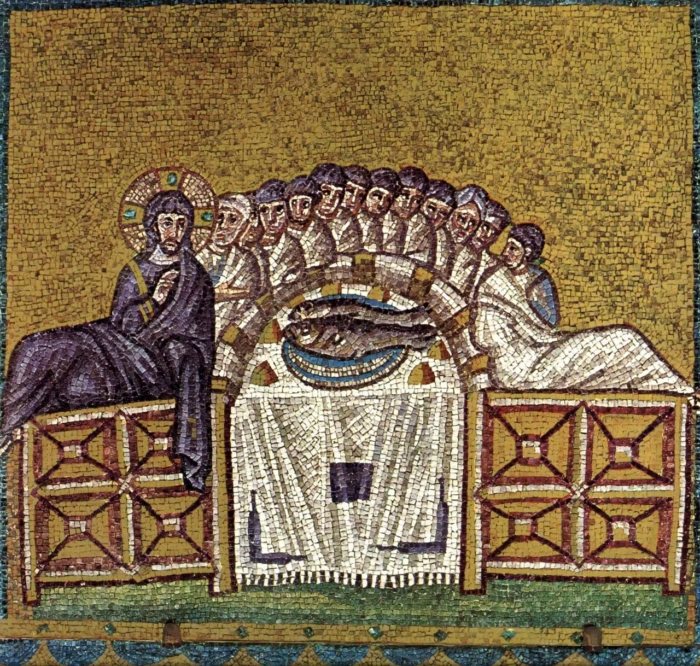
בפסיפס הזה, כפי שמראה החוקרת קתלין ליין, ישו ויהודה יושבים בשני קצות השולחן, זה מול זה, כמו שני תומכי ספרי, ואחד־עשר השליחים דחוסים ביניהם. פניו של יהודה דומות לפנים של כל השליחים. מה שמסמן אותו הוא המבט: רוב השליחים מסתכלים עליו. מאחר שגם ישו יושב בקצה השולחן, הקצה איננו מקום של גירוש.
ליין מביאה עוד שתי דוגמאות. בכתב היד של הבשורות מרוסאנו, גם הוא מהמאה השישית, מול ישו יושב פטרוס, ויהודה יושב בין השליחים. מזהים אותו לפי תנועת ידו אל הקערה, כלומר לפי המעשה שהבשורה מספרת עליו. ובבשורות של אוגוסטינוס, מסוף אותה מאה, אי אפשר לזהות אותו בכלל.
אנדריי לסיב, שחקר את האיקונוגרפיה של יהודה, מבחין בין תיאורי הסעודה האחרונה כאירוע היסטורי, שבהם יהודה מובחן משאר המשתתפים, לבין תיאורים סמליים־ליטורגיים של סעודת הקודש, שבהם ההבחנה אינה הכרחית. מבט, מעשה, היעלמות. בשלב המוקדם אין לבגידה ביטוי גופני.
יהודה אינו מחוץ לשולחן. הוא חלק מן המעגל, ואפשר לראות במיקומו בקצה השולחן את מי שמשלים את הקומפוזיציה. העובדה שהוא יושב מול ישו מאפשרת שתי קריאות: עימות והנגדה מצד אחד, קשר והשלמה מצד אחר.
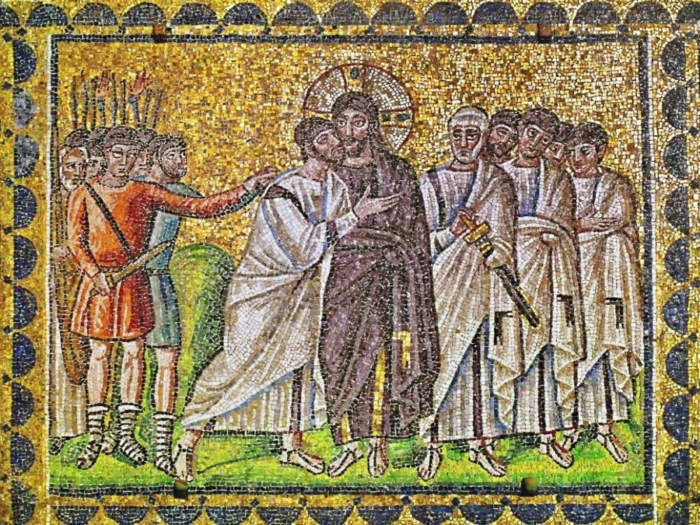
בפסיפס הזה יהודה לבוש באותה גלימה לבנה של השליחים. הוא עומד בדיוק בין החיילים לשליחים, כמו פתח בין שני עולמות. וישו לא מסתכל עליו. הוא מסתכל החוצה, אל מי שעומד מול הפסיפס.
הנשיקה, שבה יהודה מזהה את ישו בפני האנשים שבאו לעצור אותו, מעלה אפשרות אחרת: סיפור אהבה עמוקה שנגמר בטרגדיה.
יש בתנ"ך סיפור שבו בגידה ואהבה נראות כאותו מעשה. יהונתן, בנו של שאול, אוהב את דוד ומגן עליו מפני אביו. בעיני אביו ומלכו הוא בוגד, והוא עושה זאת מתוך אהבה. בסוף הוא נהרג בקרב לצד אותו אב.
דוד מקונן עליו:
״נִפְלְאַתָה אַהֲבָתְךָ לִי מֵאַהֲבַת נָשִׁים״ (שמואל ב׳, א׳, כ״ו).
האם ייתכן שמעשה שאנחנו מפרשים כבגידה קשור דווקא לאהבה, לנאמנות או להקרבה?
ככל שימי הביניים מתקדמים, הביטוי לבגידה עובר מהמבט אל הגוף.
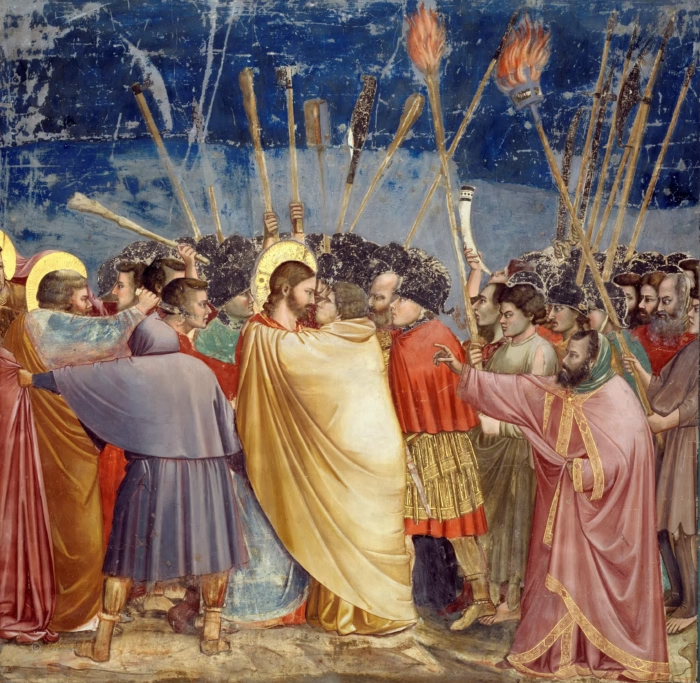
יהודה עוטף את ישו בגלימה צהובה רחבה, כמעט בולע אותו. צהוב הוא צבע שבימי הביניים הולך ונקשר לשקר, לרמאות, לבגידה ולקנאה, צבע של מי שמחוץ לסדר: בוגדים, כופרים, נוכלים, ובמקומות רבים גם יהודים. ומשם קצרה הדרך מיהודה אל היהודי.
משהו השתנה גם במבט: אם ברוונה ישו הסתכל אל הצופה, הרי שאצל ג'וטו הוא מסתכל לתוך עיניו של יהודה, ושני הפרצופים כמעט נוגעים. שניהם מצוירים בפרופיל, אבל הפרופיל של ישו חלק, והפרופיל של יהודה גס ומחוספס. באמנות של ימי הביניים הפרופיל שימש לא פעם לדמויות שליליות, וג'וטו נותן אותו לשניהם, כאילו ברגע הזה הם חולקים את אותו מבט.
סביבם לפידים, אלות וחניתות, אבל הרגע עצמו שייך רק לשניהם. באותה תמונה שבה נבנה המיתוס של יהודה המכוער, נשמר גם רגע של קרבה שהמיתוס לא מצליח למחוק.
הסעודה האחרונה היא אירוע מכונן בנצרות, וככזו היא אחד הנושאים האהובים ביותר באמנות. הייצוג המפורסם ביותר שלה הוא של לאונרדו דה וינצ'י.
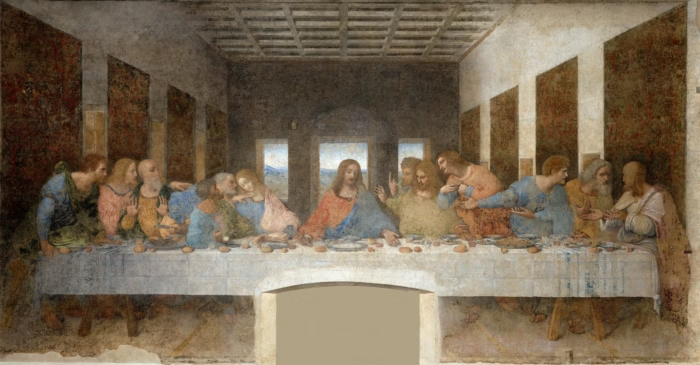
לפני שאתם ממשיכים לקרוא, נסו למצוא את יהודה.
דה וינצ'י משחק עם הצופה מחבואים. אני חיפשתי אותו בקצה הימני של התמונה, ואני מניחה שגם העין שלכם שוטטה לשם. אבל לא, הוא לא שם.
בניגוד להנחה שלי שהבוגד יושב במקום הרחוק ביותר מישו, הוא יושב צמוד למרכז, בין הקרובים והאהובים ביותר.
יהודה הוא הדמות שנרתעת לאחור, דחוקה בין פטרוס, הזקן עם השיער הלבן שמחזיק סכין, לבין יוחנן הצעיר שנוטה הצידה. פניו הן היחידות בשולחן שנמצאות בצל. ביד אחת הוא לופת ארנק, את הכסף שקיבל, והיד השנייה מושטת אל הצלחת, ממש מול היד של ישו. "הטובל ידו עמי בקערה הוא יסגירני" (מתי כ"ו, כ"ג). אותו סימן שזיהה אותו ברוסאנו, אלף שנה קודם.
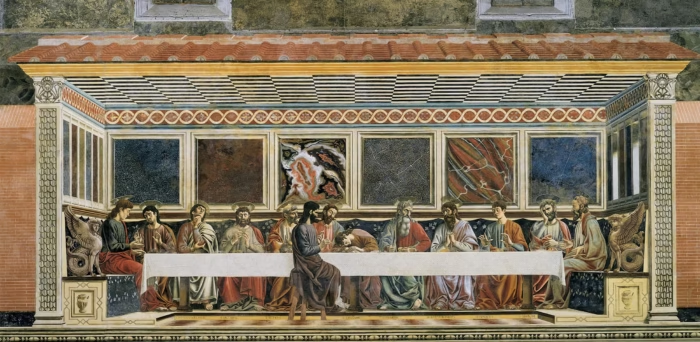
והמפתיע הוא שגם לפני לאונרדו יהודה לא ישב רחוק. אצל קסטניו, כחמישים שנה קודם, הוא יושב לבדו בצד הקרוב של השולחן, מבודד מכל השאר, אבל ממש מול ישו, במרכז. כך נהגו לצייר אותו בפירנצה של המאה ה־15, גם אצל דומניקו גירלנדאיו.
ובכל זאת זה ציור שעושה נעים בעין: שיש צבעוני, גיאומטריה מדויקת, שולחן לבן ארוך. התכנסות חביבה של חברים, ונדמה שאף אחד לא הולך למות. רק שמעל הסעודה, על אותו קיר, צייר קסטניו את הצליבה. הנזירות שאכלו מול הקיר הזה ראו בכל ארוחה את ההתכנסות למטה ואת המחיר שלה למעלה.
ויש פרט שקל לפספס: יהודה יושב עם הגב אל החדר, בצד של הנזירות. הבוגד יושב בצד של הצופים.
יהודה תמיד היה קרוב. לאונרדו רק לקח את הבוגד הגלוי והחביא אותו בין האהובים, בתוך המעגל, ועדיין מסומן: בצל ובכסף.
הבוגד נמצא בחדר, קרוב יותר ממה שאנחנו מוכנים לשער.
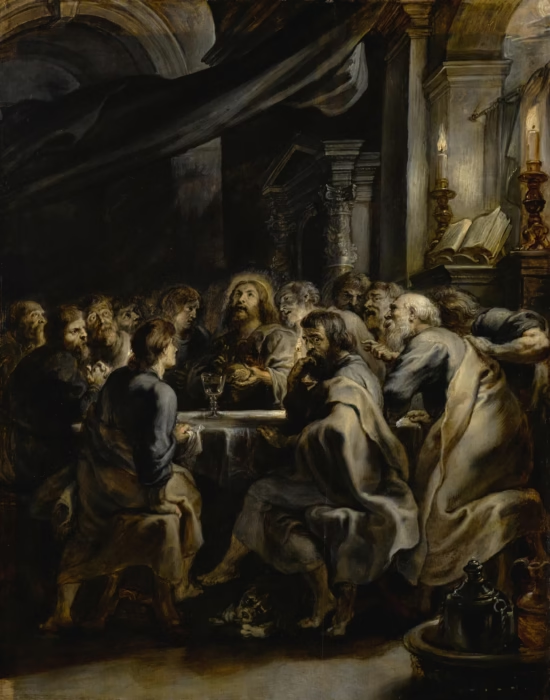
כמאה ושלושים שנה אחרי לאונרדו, רובנס מצייר את הרגע שבו ישו מברך על הלחם, את ייסוד סעודת הקודש. ישו מחזיק את הלחם ומביט למעלה, והשליחים מביטים בו. כולם חוץ מאחד. יהודה, בחזית, מסתובב מן השולחן ומסתכל ישר על הצופה. לרגליו כלב מכרסם עצם, ולפי ההיסטוריון ג'. ריצ'רד ג'דסון הכלב מסמל אולי את תאוות הבצע.
זה בדיוק הרגע הליטורגי, שבו לפי לסיב אין צורך להבחין ביהודה, ורובנס מציב אותו במרכז.
ומשהו קרה למבט לאורך כל הדרך. ברוונה ישו הסתכל על הצופה. אצל ג'וטו ישו ויהודה הסתכלו זה על זה. אצל רובנס הבוגד הוא זה שמסתכל עלינו. מי שעומד מול התמונה הופך למי שמתבוננים בו.
הבוגד נמצא בחדר, והוא גם רואה אותנו.
ב־1938 פרסם ג'ון דיקסון קאר, תחת שם העט קרטר דיקסון, את הרומן The Judas Window. ב־1981 הוא נבחר, בסקר של סופרי ומבקרי מתח, לאחד מחמשת ספרי החדר הנעול הטובים בכל הזמנים.
בבתי הסוהר הבריטיים, "חלון יהודה" הוא פתח בדלת התא שמאפשר לסוהרים להתבונן באסירים בלי שיראו אותם. אבל סר הנרי מריוויל מצביע על חלון יהודה אחר, שנמצא בכל חדר ואף אחד לא שם לב אליו.
ג'יימס אנסוול, צעיר שעומד להתחתן, מגיע לביתו של אייברי היום, אבי ארוסתו, כדי לקבל את ברכתו. היום מגיש לו כוס ויסקי, ואנסוול מאבד את ההכרה. כשהוא מתעורר, היום מוטל מת על הרצפה, וחץ נעוץ בליבו. הדלת נעולה מבפנים בבריח, החלונות מוגפים, ועל החץ טביעות האצבעות של אנסוול. אין אף אחד אחר בחדר.
רוב הספר מתרחש באולם בית המשפט. סר הנרי מריוויל מגן על אנסוול, וכל הראיות מצביעות עליו. השאלה שהספר שואל היא אם מה שנראה כמו אשמה ברורה הוא באמת מה שקרה.
נהניתי מאוד מהספר. קאר בונה את התעלומה בסבלנות, מפזר את הרמזים לעיני הקורא ומאפשר לו להסיק מסקנות בעצמו. גם כשנדמה שהצלחנו לפענח את מנגנון הרצח, הוא מצליח להפתיע. זהו ספר בלשי שנוהג בהגינות עם קוראיו, fair play בלשון חובבי הז'אנר: כל המידע הדרוש לפתרון נמצא לפנינו, והתחכום טמון באופן שבו אנחנו מפרשים אותו. העובדה שרוב העלילה מתרחשת באולם בית המשפט מחדדת את זה, משום שכל ראיה נבחנת מחדש, וכל מסקנה שנראתה מובנת מאליה עומדת שוב בספק.
הטענה של מריוויל, שבכל חדר יש חלון יהודה, הובילה אותי להרהורים על משמעותה. האם הוא מדבר רק באופן פיזי, או גם באופן מטפורי?
אם בכל חדר יש חלון יהודה, לדידי בכל חדר יש בוגד שאנחנו לא מודעים לו. הוא הופך את החדר לזירת פשע שמחכה לקרות. והוא גם מי שפועל מתוך המערכת, ורואה את מה שכולנו מסרבים לראות.
אבל מיהו הבוגד? האם די בכך שאדם מפר את האמון שנתנו בו כדי להגדיר אותו כבוגד? ומה קורה כשהנאמנות לאדם אחד מחייבת בגידה באדם אחר?
"וַיִּפָּקֵד מְקוֹם דָּוִד" (שמואל א', כ', כ"ז). הכיסא של דוד בסעודת החודש ריק, ויהונתן משקר לאביו. הוא מספר לשאול שדוד ביקש ללכת לבית לחם, לזבח משפחה (שם, כ"ח–כ"ט). שאול מבין מיד וצועק עליו: "בן נעוות המרדות" (שם, ל'), ואז מטיל בו את החנית (שם, ל"ג). בעיני שאול יהונתן בוגד, ובמובן הפשוט ביותר הוא צודק: יהונתן הפר את אמונו.
אבל יהונתן יודע מה עתיד לבוא, והוא אומר לדוד: "ואתה תמלוך על ישראל ואנכי אהיה לך למשנה" (שמואל א', כ"ג, י"ז). הוא נאמן לאהבתו לדוד ולעתיד שהוא יודע שיגיע, ומוותר מרצונו על הכתר. ובכל זאת, איש מאיתנו לא קורא לו בוגד. מה שנראה משולחן המלך כבגידה הוא נאמנות, כשמסתכלים מהמקום של יהונתן.
אצל יהודה המבנה מסתבך. יהונתן בוגד באחד מתוך נאמנות לאחר. יהודה מוסר את ישו מתוך נאמנות לישו עצמו, לשליחות שלו. בסעודה האחרונה, אחרי שיהודה לוקח את הפת, ישו אומר לו: "מה שאתה עושה, עשה מהר" (יוחנן י"ג, כ"ז). יוחנן מספר שבאותו רגע נכנס ביהודה השטן, ובכל זאת ישו אינו עוצר אותו. הוא יודע את העתיד, ומאיץ בו.
אם הצליבה הכרחית לגאולה, מישהו צריך להוביל אליה. יהודה הוא מי שמוכן לשאת על עצמו את המעשה המלוכלך, ואת אות קין שתוטבע בו לנצח.
ובאותו לילה ממש, פטרוס מתכחש לישו שלוש פעמים. האם כדי להציל את עורו? הבשורות לא מציעות סיבה אחרת. ובכל זאת, מזכירה לכם, פטרוס הופך לסלע שעליו נבנית הכנסייה. מי שבגד כדי להציל את עצמו זוכה לכבוד, ומי שעשה את מה שהיה צריך להיעשות נשאר בוגד. כמו במשחק כיסאות: כשהמוזיקה נעצרת, תמיד מישהו נשאר בלי כיסא. פטרוס מצא כיסא. יהודה לא.
בגידה, אם כן, היא שיפוט שתלוי במקום שממנו מסתכלים. מי שמציץ דרך חלון יהודה רואה רק את המעשה. מה שעומד מאחוריו נשאר מחוץ לשדה הראייה.
הספרות מכירה את הבוגד הזה היטב. אנטיגונה מפרה את פקודת קריאון וקוברת את אחיה, כי אהבתה אליו גדולה מנאמנותה לעיר. ובאותה שנה שבה קאר כתב על חלון יהודה, 1938, כתב א. מ. פורסטר, על רקע עלייתן של אידיאולוגיות טוטליטריות באירופה, שאם יצטרך לבחור בין לבגוד במולדתו לבין לבגוד בחברו, הוא מקווה שיהיה לו האומץ לבגוד במולדתו. בכל המקרים האלה הבגידה היא הפנים השניות של הנאמנות.
ויש עוד אירוניה בסיפורו של יהודה. הוא היה יהודי. גם ישו, גם פטרוס, גם יוחנן. חבורה של יהודים, שמתוכה צמח הסיפור המכונן של הנצרות. ובכל זאת, במשך הדורות יהודה נעשה היהודי שבחבורה, כאילו כל האחרים כבר הספיקו להתנצר.
השם שלו בוודאי לא עזר: יהודה, יהודי, Judas, Jude. באמנות הנוצרית הלכה דמותו וקיבלה סממנים שהזינו גם דימויים אנטישמיים. ראינו את הגלימה הצהובה של ג'וטו, את הפנים המעוותות, את הבידוד שלו בצד השני של השולחן, את הארנק של לאונרדו.
אבל אם כבר מתעקשים לזהות את יהודה עם היהודים, כדאי ללכת עם ההיגיון הזה עד הסוף. הרי לפי אותו סיפור ממש, מי שאפשר את הגאולה הנוצרית היה יהודי.
אז אולי מגיעה לנו תודה.
יש מקרים שבהם הבגידה וההצלה הן מעשה אחד, ואי אפשר להפריד ביניהן. ראשי היודנרט בגטאות נאלצו למסור רשימות כדי להציל אחרים. בספטמבר 1942 עמד חיים רומקובסקי, ראש גטו לודז', וביקש מההורים למסור את ילדיהם כדי שהגטו ישרוד. אדם צ'רניאקוב, ראש היודנרט בוורשה, שם קץ לחייו ביולי אותה שנה, כשהבין שלא יוכל לעשות זאת. אותו מצב, שתי תשובות. פרימו לוי קרא לזה "האזור האפור", והזהיר מלשפוט בקלות את מי שנאלץ לחיות בו. גם את רומקובסקי, שעליו כתב בחומרה, הוא סירב לשפוט מבחוץ.
ויש את יוזף נכוולטר, הליצן מ"סבון" של יורם קניוק. הוא מנגן לאסירים בדרך לתאי הגזים, וביניהם אשתו ובתו. אחרי המלחמה הוא משכנע את עצמו ששתק כדי לחסוך מהן את הידיעה לאן הן הולכות. קניוק כותב במפורש שזה תירוץ שבא אחר כך. מה שעצר אותו היה הפחד ממה שיחשבו עליו ברגע האחרון.
קל לראות ביוזף עוד יהודה: גם הוא מפקיר את הקרובים לו ביותר. אבל ההשוואה ביניהם מתערערת כשמסתכלים על מה שקרה אחרי המעשה. יוזף מייצר לעצמו בדיעבד סיפור שיאפשר לו לחיות עם שתיקתו. יהודה עושה בדיוק את ההפך.
הבשורות עצמן לא מקלות עליו. יוחנן קורא לו גנב, ומתי מספר על שלושים הכסף. אבל מתי מספר גם מה קרה אחר כך. יהודה מחזיר את הכסף לכוהנים, אומר "חטאתי כי הסגרתי דם נקי" (מתי כ"ז, ד'), משליך את הכסף בהיכל, והולך ותולה את עצמו.
יוזף מבקש לחיות עם המעשה. יהודה אינו מסוגל לחיות איתו. הוא מודה בחטא ומשלם עליו בחייו. אולי גם יהודה רואה את עצמו דרך החלון? קשה לקרוא את סיפורו כסיפור של אדם שפעל רק בשביל כסף.
והמילה בגידה לא יוצאת מפיו. גם במקור היווני של הבשורות, ברוב המקומות שבהם הן מספרות על מעשהו, הפועל הוא paradidōmi, "למסור". באותו פועל פאולוס מתאר את אלוהים, שמסר את בנו בעד כולנו (הרומים ח', ל"ב). ובאותו פועל, באלפיים השנים שאחרי, נאלצו ראשי היודנרט למסור רשימות.
ונשארת הנשיקה, זו שבפסיפס של רוונה. ברגע הנשיקה, כשיהודה מוסר אותו, ישו פונה אליו במילה אחת: 'רעי' (מתי כ"ו, נ').
אז אני חוזרת לשאלה ששאלתי בהתחלה. בלי יהודה אין צליבה, ובלי צליבה אין גאולה. הנצרות פתרה את זה בפסוק אחד: "בן האדם הולך כאשר כתוב עליו, אבל אוי לאיש ההוא אשר על ידו בן האדם נמסר" (מתי כ"ו, כ"ד). המעשה הכרחי, והעושה אשם. אני קוראת את זה אחרת. אם המעשה הכרחי, מי שהסכים לעשות אותו, מתוך אהבה, ולשאת את אות הבוגד לנצח, הוא זה שנשא את הגאולה על כתפיו.
יהודה, בעיניי, איננו בוגד. הוא גואל.
ובכל חדר יש חלון יהודה. השאלה היא רק מאיזה צד שלו אנחנו עומדים.
The Judas Window/ Carter Dickson
Kindle Edition, 1938, 291 Pp
דירוג SIVI –
איכות אודיו –

The Judas Window: Anatomy of Betrayal
"Judas window" is a term for a peephole, an opening through which someone watches a person who does not know they are being watched.
It is an interesting development of a term based on the figure of Judas Iscariot, regarded as the betrayer whose actions led to the crucifixion of Jesus. (And if we follow that thought all the way through, isn't he also directly responsible for the salvation of millions of Christians?)
But Judas did not always look like a traitor.
In this mosaic, as scholar Kathleen Lane shows, Jesus and Judas sit at opposite ends of the table, facing one another like two bookends, with the eleven apostles crowded between them. Judas's face resembles the faces of all the other apostles. What marks him is the gaze: most of the apostles are looking at him. Since Jesus also sits at the end of the table, the edge is not a place of exclusion.
Lane gives two more examples. In the Rossano Gospels, also from the sixth century, Peter sits opposite Jesus while Judas sits among the apostles. He is identified by the movement of his hand toward the bowl, that is, by the action described in the Gospel. And in the Augustine Gospels, from the end of the same century, he cannot be identified at all.
Andriy Lesiv, who studied the iconography of Judas, distinguishes between depictions of the Last Supper as a historical event, in which Judas is differentiated from the other participants, and symbolic-liturgical depictions of the Eucharist, in which such differentiation is not necessary. A gaze, an act, disappearance. At this early stage, betrayal has no physical expression.
Judas is not outside the table. He is part of the circle, and his position at the end of the table can be seen as completing the composition. The fact that he sits opposite Jesus allows for two readings: confrontation and opposition on one hand, connection and completion on the other.
In this mosaic, Judas wears the same white robe as the apostles. He stands exactly between the soldiers and the disciples, like a threshold between two worlds. And Jesus does not look at him. He looks outward, toward whoever is standing in front of the mosaic.
The kiss, through which Judas identifies Jesus to the men who have come to arrest him, raises another possibility: a story of deep love that ends in tragedy.
There is a story in the Hebrew Bible in which betrayal and love look like the same act. Jonathan, Saul's son, loves David and protects him from his father. In the eyes of his father and his king, he is a traitor, and he does it out of love. In the end he is killed in battle beside that same father.
David laments him:
"Your love for me was wonderful, more than the love of women" (2 Samuel 1:26).
Could it be that an act we interpret as betrayal is actually connected to love, loyalty or sacrifice?
As the Middle Ages progress, the expression of betrayal moves from the gaze to the body.
Judas wraps Jesus in a broad yellow cloak, almost swallowing him. During the Middle Ages, yellow increasingly became associated with falsehood, deceit, betrayal and jealousy, a color belonging to those outside the social order: traitors, heretics, swindlers and, in many places, Jews as well. From there, the distance between Judas and the Jew is very short.
Something has changed in the gaze too. If in Ravenna Jesus looked toward the viewer, in Giotto he looks directly into Judas's eyes, their two faces almost touching. Both are shown in profile, but Jesus's profile is smooth while Judas's is coarse and rough. In medieval art, profile was often used for negative figures, and Giotto gives it to both of them, as though for this moment they share the same gaze.
Around them are torches, clubs and spears, but the moment itself belongs only to the two of them. In the same image in which the myth of the ugly Judas takes shape, a moment of intimacy remains that the myth cannot erase.
The Last Supper is a foundational event in Christianity and, as such, one of the most frequently depicted subjects in Christian art. Its most famous representation is Leonardo da Vinci's.
Before you continue reading, try to find Judas.
Da Vinci plays hide-and-seek with the viewer. I looked for him at the far right of the image, and I assume your eye wandered there too. But no, he is not there.
Contrary to my assumption that the betrayer would be sitting as far away from Jesus as possible, he sits close to the center, among those nearest and most beloved.
Judas is the figure recoiling backward, wedged between Peter, the older man with white hair holding a knife, and the young John leaning to the side. His face is the only one at the table that lies in shadow. In one hand he clutches a purse, the money he received, while the other reaches toward the dish, directly opposite Jesus's hand. "He who dipped his hand with me in the dish will betray me" (Matthew 26:23). The same sign that identified him in Rossano a thousand years earlier.
And what is surprising is that even before Leonardo, Judas did not sit far away. In Castagno's version, painted about fifty years earlier, he sits alone on the near side of the table, isolated from everyone else but directly opposite Jesus, in the center. This was a common way of depicting him in fifteenth-century Florence, including in the work of Domenico Ghirlandaio.
And yet it is an image that is pleasing to the eye: colored marble, precise geometry, a long white table. A pleasant gathering of friends, and it seems as though no one is about to die. Except that above the supper, on the same wall, Castagno painted the Crucifixion. The nuns who ate facing this wall saw, at every meal, the gathering below and its price above.
And there is one detail that is easy to miss: Judas sits with his back to the room, on the side of the nuns. The betrayer sits on the side of the viewers.
Judas was always close. Leonardo simply took the openly marked betrayer and hid him among the beloved, inside the circle, while still marking him: with shadow and money.
The betrayer is in the room, closer than we are willing to imagine.
About a hundred and thirty years after Leonardo, Rubens paints the moment in which Jesus blesses the bread, the institution of the Eucharist. Jesus holds the bread and looks upward, while the apostles look at him. Everyone except one. Judas, in the foreground, turns away from the table and looks directly at the viewer. At his feet, a dog gnaws a bone, and according to historian J. Richard Judson, the dog may symbolize greed.
This is precisely the liturgical moment in which, according to Lesiv, there is no need to distinguish Judas, yet Rubens places him at the center.
And something has happened to the gaze along the way. In Ravenna, Jesus looked at the viewer. In Giotto, Jesus and Judas looked at one another. In Rubens, the betrayer is the one looking at us. The person standing before the painting becomes the person being watched.
The betrayer is in the room, and he sees us too.
In 1938, John Dickson Carr, writing under the pseudonym Carter Dickson, published the novel "The Judas Window". In 1981 it was chosen, in a poll of crime writers and critics, as one of the five best locked-room mysteries of all time.
In British prisons, a "Judas window" is an opening in a cell door that allows guards to observe prisoners without being seen. But Sir Henry Merrivale points to another Judas window, one that exists in every room and that no one notices.
James Answell, a young man about to be married, arrives at the home of Avery Hume, the father of his fiancee, to ask for his blessing. Hume gives him a glass of whisky, and Answell loses consciousness. When he wakes up, Hume is lying dead on the floor with an arrow through his heart. The door is bolted from the inside, the windows are shut, and Answell's fingerprints are on the arrow. There is no one else in the room.
Most of the book takes place in a courtroom. Sir Henry Merrivale defends Answell, and all the evidence points to him. The question the book asks is whether what looks like obvious guilt is really what happened.
I enjoyed the book very much. Carr builds the mystery patiently, scatters the clues in front of the reader and allows us to draw our own conclusions. Even when it seems that we have worked out the mechanism of the murder, he still manages to surprise us. This is detective fiction that plays fair with its readers, "fair play" in the language of mystery enthusiasts: all the information needed to solve the case is placed before us, and the cleverness lies in the way we interpret it. The fact that most of the plot takes place in a courtroom sharpens this, because every piece of evidence is examined again and every conclusion that once seemed self-evident is thrown back into doubt.
Merrivale's claim that every room contains a Judas window led me to think about what it means. Is he speaking only in a physical sense, or in a metaphorical one as well?
If every room has a Judas window, then to my mind every room contains a betrayer we do not know about. He turns the room into a crime scene waiting to happen. And he is also the person acting from within the system, seeing what all of us refuse to see.
But who is the betrayer? Is breaking the trust someone placed in us enough to define us as traitors? And what happens when loyalty to one person requires betrayal of another?
"David's place was empty" (1 Samuel 20:27). David's seat at the New Moon feast is vacant, and Jonathan lies to his father. He tells Saul that David asked permission to go to Bethlehem for a family sacrifice (28-29). Saul understands immediately and cries out at him, "You son of a perverse, rebellious woman" (30), then hurls his spear at him (33). In Saul's eyes Jonathan is a traitor, and in the simplest sense he is right: Jonathan has betrayed his trust.
But Jonathan knows what is to come, and he tells David: "You shall be king over Israel, and I shall be next to you" (1 Samuel 23:17). He is loyal to his love for David and to the future he knows will come, and willingly gives up the crown. And yet none of us calls him a traitor. What looks like betrayal from the king's table is loyalty when seen from Jonathan's place.
With Judas, the structure becomes more complicated. Jonathan betrays one person out of loyalty to another. Judas hands Jesus over out of loyalty to Jesus himself, to his mission. At the Last Supper, after Judas takes the piece of bread, Jesus tells him: "What you are doing, do quickly" (John 13:27). John tells us that at that moment Satan entered Judas, and yet Jesus does not stop him. He knows the future, and urges him on.
If the Crucifixion is necessary for salvation, someone has to lead to it. Judas is the one willing to take the dirty act upon himself, and to carry the mark of Cain that will be stamped on him forever.
And on that very same night, Peter denies Jesus three times. Was it to save his own skin? The Gospels offer no other explanation. And yet, let me remind you, Peter becomes the rock on which the Church is built. The man who betrayed in order to save himself is honored, while the man who did what had to be done remains the betrayer. Like a game of musical chairs: when the music stops, someone is always left without a chair. Peter found one. Judas did not.
Betrayal, then, is a judgment that depends on where we are standing. Whoever looks through a Judas window sees only the act. What lies behind it remains outside the field of vision.
Literature knows this betrayer well. Antigone defies Creon's command and buries her brother because her love for him is greater than her loyalty to the city. And in the same year Carr wrote about a Judas window, 1938, E. M. Forster wrote, against the background of the rise of totalitarian ideologies in Europe, that if he had to choose between betraying his country and betraying his friend, he hoped he would have the courage to betray his country. In all these cases, betrayal is the other face of loyalty.
And there is another irony in the story of Judas. He was Jewish. So were Jesus, Peter and John. A group of Jews from which the foundational story of Christianity emerged. And yet, over the centuries, Judas became the Jew among them, as though everyone else had already managed to become Christian.
His name certainly did not help: Yehuda, Yehudi, Judas, Jude. In Christian art his figure gradually acquired features that also fed antisemitic imagery. We have seen Giotto's yellow cloak, the distorted features, his isolation on the other side of the table, Leonardo's purse.
But if we insist on identifying Judas with the Jews, perhaps we should follow that logic all the way through. According to that very same story, the man who made Christian salvation possible was a Jew.
So perhaps we deserve a thank-you.
There are situations in which betrayal and rescue are the same act, and cannot be separated. Heads of the Judenrat in the ghettos were forced to hand over lists in order to save others. In September 1942, Chaim Rumkowski, head of the Lodz Ghetto, stood before the parents and asked them to give up their children so that the ghetto might survive. Adam Czerniakow, head of the Judenrat in Warsaw, took his own life in July of that year when he understood that he could not do the same. The same situation, two answers. Primo Levi called this "the gray zone", and warned against judging too easily those who were forced to live within it. Even Rumkowski, about whom he wrote harshly, he refused to judge from the outside.
And then there is Joszef Nachwalter, the clown from Yoram Kaniuk's "Soap". He plays music for prisoners on their way to the gas chambers, among them his wife and daughter. After the war he convinces himself that he remained silent in order to spare them the knowledge of where they were going. Kaniuk states explicitly that this was an excuse invented afterward. What stopped him was the fear of what they would think of him in their final moments.
It is easy to see Joszef as another Judas: he too abandons those closest to him. But the comparison begins to fall apart when we look at what happened after the act. Joszef creates a story for himself after the fact that will allow him to live with his silence. Judas does exactly the opposite.
The Gospels themselves do not make things easy for him. John calls him a thief, and Matthew tells us about the thirty pieces of silver. But Matthew also tells us what happened afterward. Judas returns the money to the priests, says, "I have sinned by betraying innocent blood" (Matthew 27:4), throws the money into the temple, and goes away and hangs himself.
Joszef wants to live with the act. Judas cannot live with it. He admits his sin and pays for it with his life. Perhaps Judas, too, sees himself through the window. It is difficult to read his story as the story of a man who acted only for money.
And the word "betrayal" does not come from his mouth. Even in the original Greek of the Gospels, in most of the passages that describe his act, the verb is paradidomi, "to hand over". Paul uses the same verb to describe God, who handed over his Son for us all (Romans 8:32). And with that same verb, in the two thousand years that followed, heads of the Judenrat were forced to hand over lists.
And the kiss remains, the one in the Ravenna mosaic. At the moment of the kiss, when Judas hands him over, Jesus addresses him with a single word: "Friend" (Matthew 26:50).
So I return to the question I asked at the beginning, in parentheses. Without Judas there is no Crucifixion, and without the Crucifixion there is no salvation. Christianity resolved this in a single verse: "The Son of Man goes as it is written of him, but woe to that man by whom the Son of Man is handed over" (Matthew 26:24). The act is necessary, and the person who performs it is guilty. I read it differently. If the act is necessary, then the person who agreed to perform it, out of love, and to bear the mark of the betrayer forever, is the one who carried salvation on his shoulders.
Judas, in my eyes, is not a traitor. He is a redeemer.
And every room has a Judas window. The only question is which side of it we are standing on.
לגלות עוד מהאתר Sivi's Books
Subscribe to get the latest posts sent to your email.